
Violence, censorship and media in Colombia: effects of the 'Bogotazo' and the collapse in radio broadcasts
Article Sidebar
Downloads
Section
Total or partial reproduction of the contents of the journal are authorized for educational, investigative or academic purposes as long as the source is cited. In order to make reproductions for other purposes, it is necessary to have the express authorization of the imprint or Sello Editorial of the Universidad de Medellín.
Main Article Content
Abstract
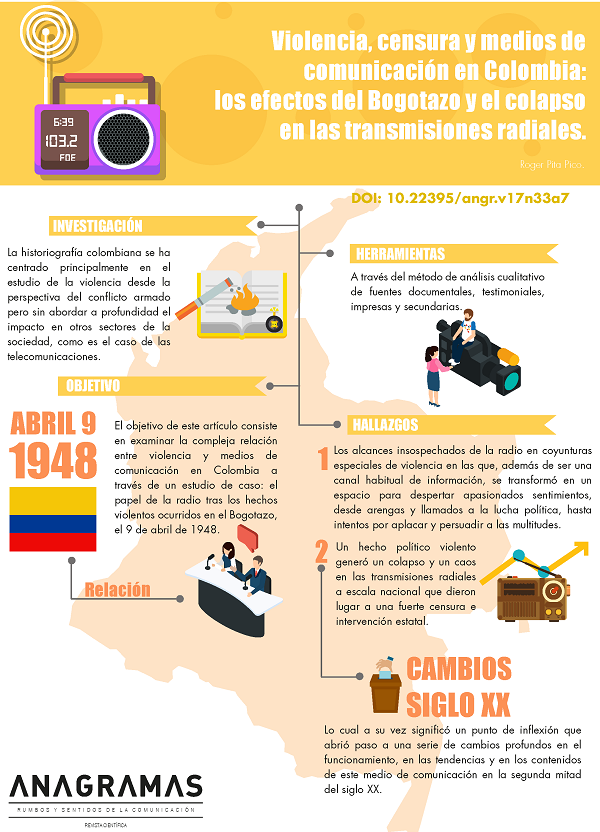
Colombian historiography has focused mainly on the study of violence from the perspective of the armed conflict but without addressing in depth the impact on other sectors of society, such as telecommunications. That is why, through the method of qualitative analysis of documentary, testimonial, printed and secondary sources, the goal of this paper is to examine the complex relationship between violence and media in Colombia through a case study: The role of the radio after the violent events that occurred in the 'Bogotazo' on April 9, 1948.
Thus, it is intended to show, on the one hand, the unsuspected reaches of the radio in special conjunctures of violence in which, in addition to being a habitual channel of information, it was transformed into a space to awaken passionate feelings: from harangues and calls to the political struggle, even attempts to placate and persuade the crowds. On the other, it is observed how a violent political event caused a collapse and chaos in the radio broadcasts on a national scale that led to a strong censorship and state intervention, which in turn meant a turning point that opened the way to a series of profound changes in the functioning, trends and content of this media in the second half of the twentieth century.